Roof Repairs
Repairs on Inner West terraces and semis, where box gutters, parapet flashings and shared roof junctions cause nearly every leak.
Read moreA brown ring on the bedroom ceiling after a short, heavy storm usually means the box gutter behind the parapet backed up — not that a tile slipped. We inspect free and tell you which one it is.
Stand on Darling Street in Balmain, King Street in Newtown or Ramsay Street in Haberfield and look up. You will see parapets, chimney stacks and the odd sliver of slate — almost no guttering. That is the whole problem in one view.
On attached housing, rainwater is not thrown off an eave and down a pipe. It is collected in a box gutter sitting between two brick parapets, carried along a shallow fall to a sump, and dropped down a single pipe. When that one path blocks or the lining splits, the water has nowhere else to go but over the back of the gutter and into your ceiling.
That is the fault we are called to most often, and it is why a stained cornice in a Petersham terrace needs a different diagnosis to a stained cornice in a Concord bungalow.
Call (02) 8000 1103 or ask for a free quote and someone will get up there and look properly.
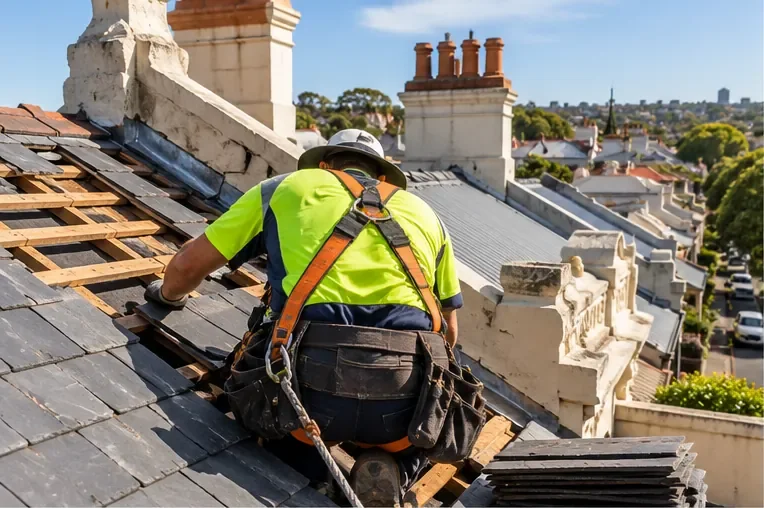
A box gutter on a Class 1 home is designed for a very short, very intense burst of rain — the 1% AEP five-minute intensity, with a minimum 200 mm flat base and 30 mm of freeboard left spare for wind-driven spill. Add a tennis ball of leaf litter at the sump and that design margin disappears. Many older Inner West box gutters also have no independent overflow at all, so there is nothing to dump the excess safely to the outside of the building.
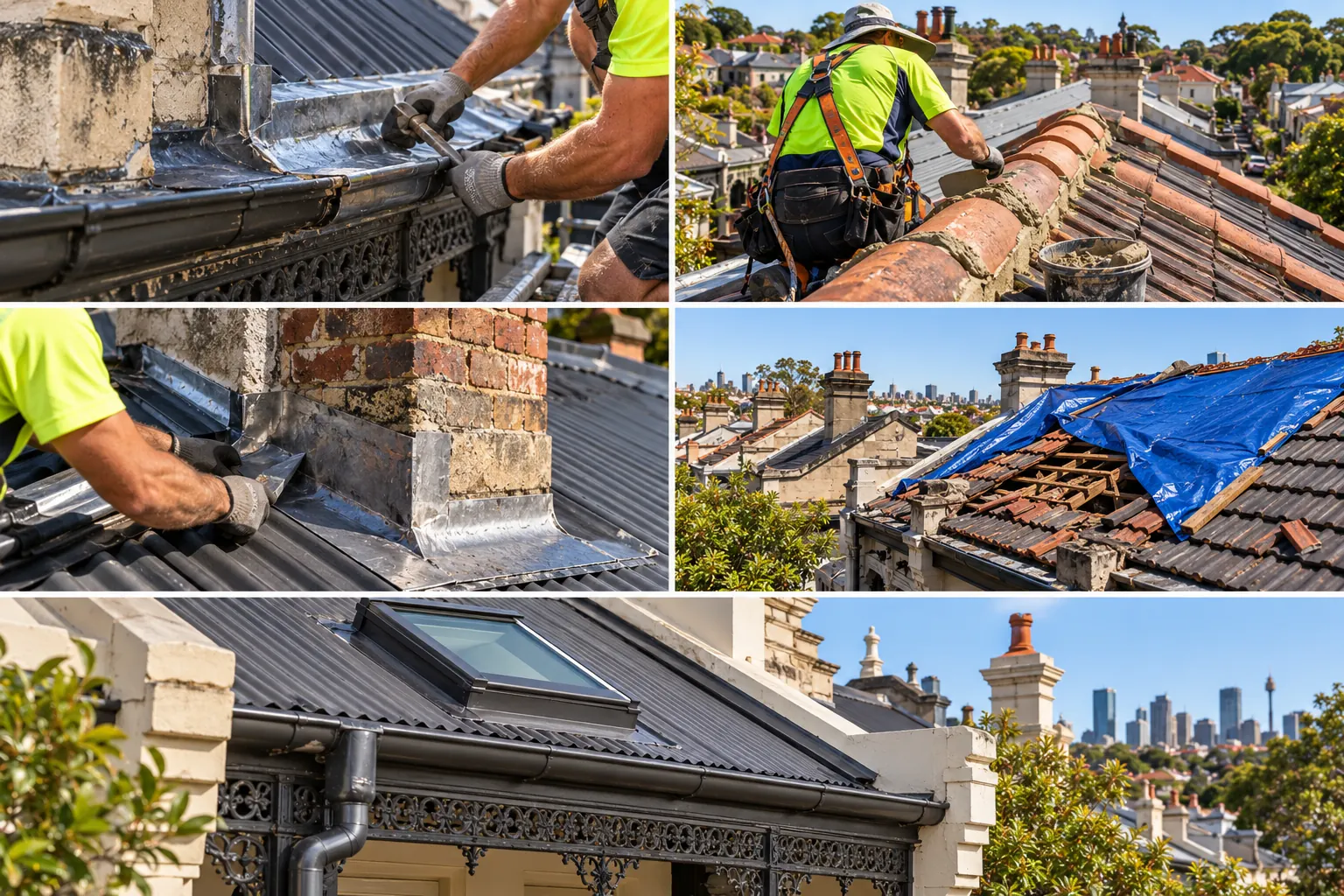
The top of a parapet is exposed brickwork, often with a failing capping or no damp-proof course left in it. Water soaks down inside the wall and surfaces metres away from where it got in. Finding it means tracing the wall, not just the roof.
Where your roof meets next door, there is a flashing that belongs to both houses. These get patched by different trades over decades, sealed with silicone that has gone hard, and end up as the leak nobody wants to own. We are comfortable working these junctions, and that is a large part of why people call.
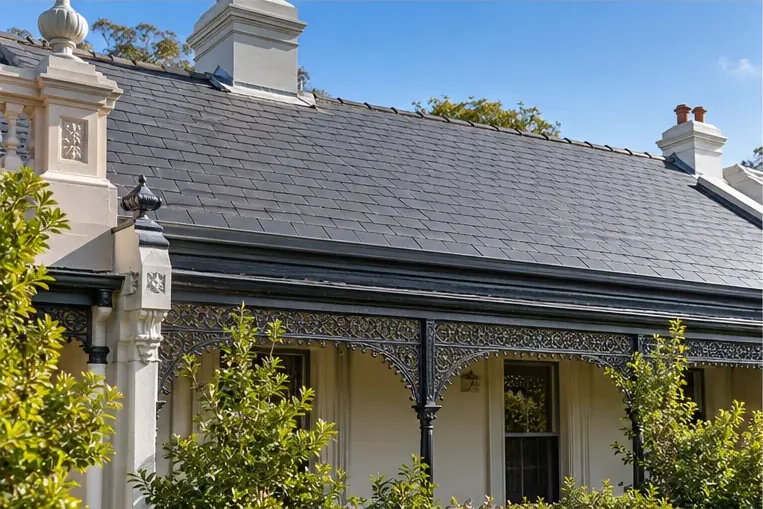
Original slate was fixed with iron nails. Once the nails corrode, slates slip one at a time and the roof starts shedding onto the footpath. The slate itself is often fine; the fixings are not. That distinction decides whether you are looking at a repair or a re-slate.
The 29 suburbs we cover are not one housing type. Through Strathfield, Burwood, Haberfield and Concord there are large Federation homes on real blocks, with deep eaves, terracotta tile and prominent gables — the Churchill Avenue, Homebush Road and Redmyre Road conservation areas in Strathfield are full of Federation Queen Anne roofs with complicated valleys. Dulwich Hill, Summer Hill and Croydon are mostly inter-war brick with tiled hips. Earlwood, Canterbury and Hurlstone Park add post-war stock on the ridges above the Cooks River.
Those roofs fail in ordinary ways: crumbling ridge pointing, rusted valley irons, blocked eaves gutters, cracked tiles under foot traffic. They are also far easier to access than a terrace with no side path.
Which half you live in changes the method, the materials and the cost. See the areas we cover for the detail on your suburb.
A Rozelle terrace with a zero setback to the footpath, a one-metre rear lane and no side gate is a scaffolding job before it is a roofing job. Pretending otherwise is how homeowners end up with a quote that doubles halfway through.
We look at how gear gets in, whether a footpath or kerb occupation is needed, and whether the work can be reached from your own roof. That goes in the written quote with everything else, so the number you are given is the number.
The inspection is free and carries no obligation. You get a plain explanation of what is happening, the options, and a written quote. Work is carried out by established, licensed and insured roofing contractors working to NSW Fair Trading requirements, and every completed job carries a written workmanship warranty.
Call (02) 8000 1103 or send through the details and we will come and look.
Repairs on Inner West terraces and semis, where box gutters, parapet flashings and shared roof junctions cause nearly every leak.
Read moreRe-roofing Victorian and Federation terraces, semis and workers cottages, including slate and heritage-area work.
Read moreColorbond and metal roofing across the Inner West, including the low-pitch and concealed-gutter roof forms common on terraces.
Read moreRestoration for Inner West tile roofs, and recoating where a heritage conservation area limits what can change.
Read moreBox gutter replacement and parapet flashing across the Inner West, the single most common source of ceiling damage on attached housing.
Read moreStorm response across the Inner West, where a blocked box gutter can flood a ceiling within minutes.
Read moreRoof inspections and written reports across the Inner West, including pre-purchase checks on terraces and slate roofs.
Read moreWe inspect at no cost and explain the options in plain terms before you commit.
Work is carried out by established, licensed and insured roofing contractors working to NSW Fair Trading requirements.
Box gutters, parapets and shared roof junctions on attached housing — the work most roofers avoid.
Every job carries a written workmanship warranty.
Tell us what you need and we'll get straight back to you. Prefer to talk? Call (02) 8000 1103 and speak to someone local.
Call (02) 8000 1103A box gutter is a flat-bottomed metal channel that runs between two parapet walls, inside the roof line rather than hanging off an eave. Terraces and semis were built this way because they share walls and have no eaves to hang a gutter from. The water collects in that channel and leaves through a sump and a single downpipe, usually at the back.
Slate is still on a lot of the older Victorian stock through Balmain, Newtown, Annandale and Stanmore, and it is handled differently to tile. Slates are hung on nails or hooks rather than bedded in mortar, the flashings are lead rather than pressed metal, and broken slates are cut and slipped in individually. Repairs and full re-slating can both be quoted.
No, but it changes how the job is set up. A party-wall flashing sits half on each property, and reaching your box gutter sometimes means standing on the roof next door. We work out the access before quoting and tell you plainly if a neighbour needs to be asked, so nobody is surprised on the morning the work starts.
Often, yes. Much of the Inner West sits inside a listed heritage conservation area, and the controls can reach the roof covering, the colour and the visible profile from the street. Haberfield is listed as C54 under the Inner West LEP 2022, with extra built-form controls in clause 6.20. We specify work that respects those controls and tell you when a development application is likely.
Call (02) 8000 1103 and describe where the water is appearing and how fast. Active internal leaks are triaged ahead of planned work. The first visit is about make-safe — stopping water entering the ceiling — and a permanent repair is quoted once the roof is dry enough to be properly assessed.